An office with two people, desks and monitors, potted plants, a trash bin, and a purple hand sanitizer dispenser above a cabinet.

How to keep hybrid offices clean

Hybrid working has become an increasingly popular way for businesses to operate. And as office spaces become more flexible, keeping them clean and hygienic brings new dynamics. These include different teams coming in on different days, sharing desks with several colleagues, and some common spaces getting used more than others.

While hybrid work adds complexity to the facility manager’s job, it doesn’t have to be a hurdle. A well-planned cleaning strategy tailored to hybrid work patterns, combined with employees who understand their role in keeping the space tidy, can make keeping offices spotless and safe not only achievable but even help your business stand out from competitors.

Why does hybrid work matter?

According to data from the U.S Bureau of Labor Statistics, 22.1% of workers have done their job remotely at least some of the time in 2025 compared to 17.9% in 2022. [1]
 
This dynamic provides greater flexibility and work-life balance for employees, as well as benefits for businesses, such as improved retention, reduced turnover costs, and fewer costly employee absences. [2]
 
With flexible working arrangements seemingly here to stay, your business will likely have to continue to adapt its operations. Now, office spaces need to support rotating teams and more fluid schedules, which means it may be time to consider an alternative approach to workplace cleaning.
 
So, what could that look like in practice? Let's find out!
 

Person wrapped in a blanket, sitting in a purple chair, holding a tissue to their face and a mug in the other hand.


Make hygiene and cleaning products easily accessible

*Maintaining hygiene and cleaning standards in any facility is everyone's responsibility, especially in high-traffic and shared spaces. And you can enable employees to do their part by placing the right products strategically and within reach. These include:

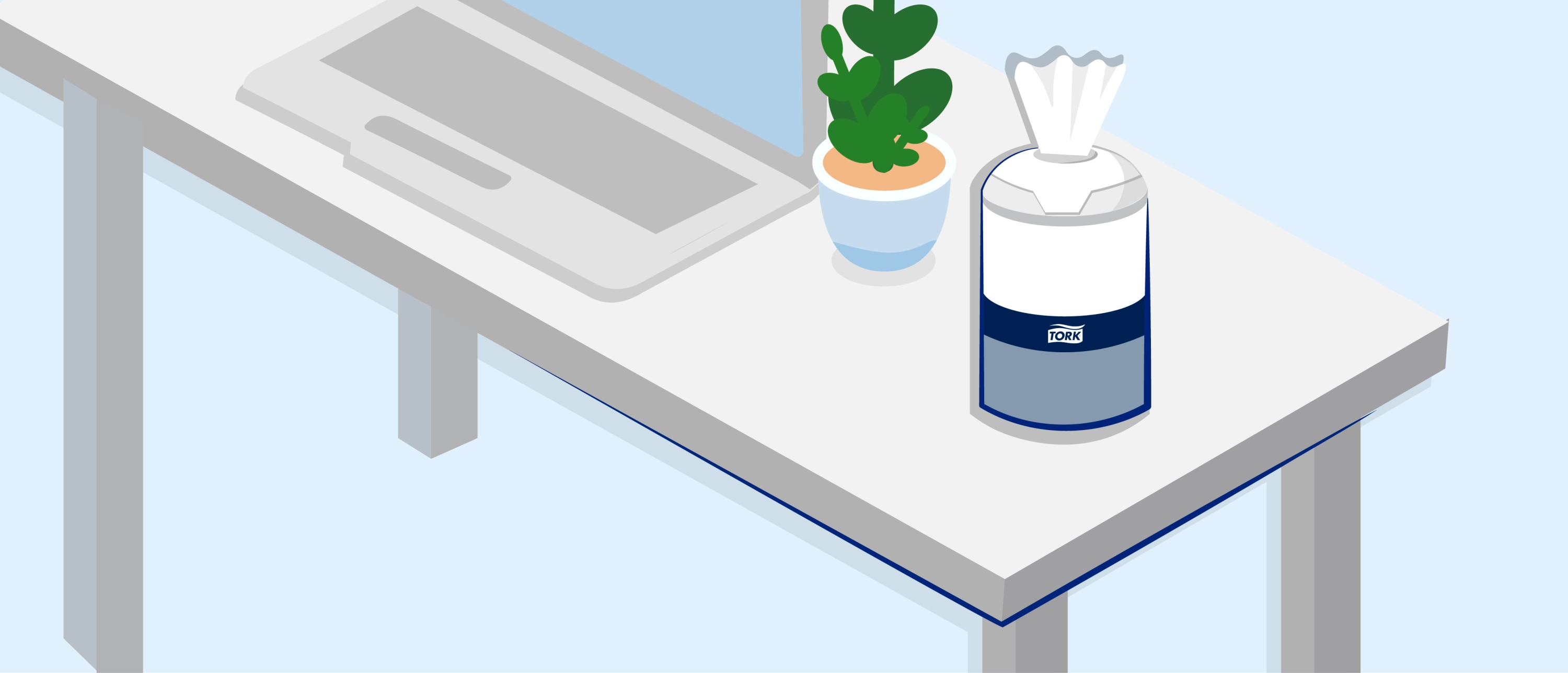
Desk with a laptop, a small potted plant, and a container of Tork disinfectant wipes with one wipe partially pulled out.

Create a thorough cleaning schedule

 There are certain aspects of a cleaning plan that should always be considered no matter how busy your office is, including:
  • Regularly cleaning high-touch areas (door handles, kitchen areas, desks, elevator buttons, and restroom fixtures).
  • Conducting routine deep cleans of the entire facility.
  • Properly stocking cleaning supplies and hygiene products, both for janitorial and employee use.

 

Door displaying a clipboard with a cleaning schedule showing a calendar grid with checkmarks, next to a potted plant.


Keeping track of hygiene product availability, especially in a larger facility, can be a tricky task. However, with Tork Vision Cleaning, your cleaning staff can easily know when dispensers need refilling. This allows you to optimize your teams’ time without compromising on hygiene standards.

When it comes to designing a cleaning schedule for a hybrid facility, there are a few particular aspects to consider:

  • Allow room for flexibility in your schedule and among your cleaning teams to accommodate for changes in working patterns. For example, with increased office presence, you may need to add shifts to your cleaning program. 
  • Clearly define rules and responsibilities for your cleaning teams to follow. This could involve placing desk signage that instructs employees on cleaning procedures, like wiping surfaces and equipment after use.
 

Use a desk reservation system

One of the biggest challenges of hybrid office cleaning is knowing which areas to prioritize. At least when it comes to desks, this can be made easier with the right technology. 
 
Desk reservation software can help your staff track which workspaces were used and when, making it easier to target cleaning efforts where they’re most needed. This avoids unnecessarily taking care of unused areas while making sure that high-touch surfaces in busy spaces are always ready for the next user. 
 
This type of software doesn't just benefit cleaning teams either. Allowing employees to reserve their desks ahead of time eliminates the uncertainty of arriving at the office and searching for a place to sit and work. Additionally, it helps you monitor office capacity, enabling decisions about how best to use space and resources. For instance, if certain desks or areas are rarely used, they could be repurposed into collaboration zones, storage, or downsized to reduce overhead costs.
 

Train employees on hybrid working hygiene practices

Initially, hybrid and remote working grew in popularity out of necessity but then became a new way for many businesses to thrive. They did this by adapting multiple processes, especially when it came to hygiene practices. 
 
For employees to operate in hybrid spaces safely and effectively, it’s essential to continue reminding them of these standards, including:
 

Practicing proper hand hygiene

Hand hygiene in any facility is incredibly important for the success of your business. Good hand hygiene reduces the spread of germs at work and at home, making it less likely that your employees will fall ill. Fewer illnesses mean fewer absences and higher productivity — directly supporting better business outcomes. The same applies to hybrid workplaces.
 
There are 5 simple key steps for washing hands correctly. Share them with your workforce as follows: [3]
  1. Wet - Wet your hands with clean, running warm water. Turn the tap off and apply soap. 
  2. Lather - Rub your hands with hand soap. Lather between the fingers, the back of the hands, and under the nails. 
  3. Scrub - Scrub your hands together until you've completely spread the soap across them. This should be done for around 20 seconds.
  4. Rinse - Turn the tap back on and rinse your hands in clean, running water. 
  5. Dry - Use a paper hand towel to dry your hands. 
To help employees follow these steps effectively, visibility and education are key. For hybrid workplaces, that means communicating this important message both in the office and remotely. 
 
On premises, clear and accessible signage combined with training sessions on good hand hygiene can be a great way to address this. On the other hand, virtual and online courses, as well as emailing resources to employees, allow you to break down communication barriers.


Cleaning desks at the end of the work day

In hybrid offices where desks are often shared and used by different people on different days, a clean desk policy plays an important role in maintaining cleanliness and hygiene. 
 
By encouraging employees to clear their workplace at the end of each day — removing personal items, food, containers, and litter — it becomes easier for your cleaning teams to do their job effectively. Not to mention that working at a clean desk can minimize distractions, increasing productivity, and foster a feeling of belonging and respect for the office space.
 
Clean desk policies might be adapted to fit your specific business's needs, but here is a simple template you can send to your employees:
 
Tork Clean Desk Policy
Nice and tidy
  • When your desk is clean and free from paper and clutter, your office space looks attractive, professional, and efficient. You’ll feel more in control in a well-organized environment. 
  • When sharing desks, minimize clutter. That way, you can easily switch to meeting rooms without too much hassle or leave your desk at the end of the day. 
  • A clutter-free desk is easier to keep clean.

Hygienic
  • Sharing desk space, keyboards, and other accessories with colleagues comes with potentially increased hygiene risks.
  • Wipe and disinfect all surfaces to minimize the hygiene risk.
  • Wash your hands properly to keep yourself and your colleagues healthy.
  • Don’t come to the office if you are ill.

Secure
  • When you leave your desk, check to see if there is any visible sensitive information and place it inside a folder or off your desktop. 
  • For additional security, make sure to switch on your computer's password-protected screen saver.
  • Don’t write down passwords on sticky notes or paper.
  • Pay attention to your background when you are in online meetings and make sure confidential information is not displayed when sharing your screen. 
  • You may not know who will be using your desk when you leave it: keep control of sensitive information to reduce the risk of a data breach and identity theft. 
  • When you leave your desk for the day, don’t leave papers, sticky notes, or other documents on it, especially if they contain sensitive information. 
Even though it may take some getting used to, hybrid office hygiene and cleanliness don’t have to be complicated. It just takes a bit of smart strategy, the right tools, and a shared commitment from everyone in the workspace. By stocking up on the right products, adjusting cleaning schedules, encouraging good hygiene habits, and leveraging technology, businesses like yours can create a welcoming and safe environment for everyone, no matter how often they’re in the office.
 
If you're looking to dive deeper into office maintenance, check out our quick office cleaning guide. Or why not discover our tips for ensuring personal hygiene and cleanliness at work?


References: